
MIYA Chat Intelligence
An enterprise AI knowledge assistant combining document-grounded chat, governed content management, and usage analytics.
Overview
MIYA Chat Intelligence connects conversational AI with the controls needed to manage enterprise knowledge.
Users can ask questions over published documents, explore the knowledge directory, and analyze uploaded files with persistent conversation history. Administrators manage document lifecycles, review unanswered questions and feedback, and monitor usage, latency, and token consumption. A Next.js dashboard and FastAPI single-agent backend integrate with Azure services for document processing, retrieval, and persistence. Conversational access to governed enterprise knowledge Business context Enterprise knowledge tools serve employees seeking answers and administrators responsible for content quality. MIYA brings document availability, chat history, feedback, and operational monitoring into a shared dashboard. Objectives - Enable questions over published knowledge and uploaded files. - Keep retrieval aligned with publication, hierarchy, and content versions. - Provide visibility into unanswered questions, feedback, and usage. Solution architecture - Next.js workspace Authenticated React dashboard and session-aware browser BFF. - FastAPI and chat agent Knowledge write authority and a single agent with document, directory, uploaded-file, and unanswered-question tools. - Document processing Blob Storage, Document Intelligence, embeddings, and optional Durable Functions support the indexing lifecycle. - Knowledge retrieval Azure AI Search supplies document chunks subject to publication, version, scope, and projection-readiness checks. - Application persistence Cosmos DB stores application records, knowledge metadata, operations, and audit records. Workflow - Organize knowledge Manage folders, files, and publication in the content library. - Process and index Extract document content, generate embeddings, and synchronize the search projection. - Ask and retrieve Search published knowledge or uploaded files, with document-specific or recursive folder scope when needed. - Review and improve Administrators review unanswered questions, feedback, conversation logs, and usage analytics. Engineering challenges - Prevent stale retrieval Document changes and asynchronous indexing can leave search temporarily out of step with authoritative metadata. Fail closed on invalid node state, content version, scope revision, or search-projection readiness. Content can remain unavailable during synchronization rather than expose stale results. - Separate service responsibilities Browser authentication, knowledge writes, and long-running processing require distinct boundaries. Use Next.js for browser sessions, FastAPI for knowledge authority, and optional Durable Functions for lifecycle orchestration. Multiple services require coordinated configuration and monitoring. Lessons learned - Retrieval correctness depends on lifecycle state as well as relevance. - Human review of unanswered questions complements automated retrieval. - Separate implemented capabilities from unverified business outcomes.
Case study
- 01
The challenge
An internal AI assistant needs more than document search: it must distinguish published knowledge from unavailable content, keep retrieval aligned with document changes, and support administrator review of unanswered questions. The challenge is to connect these controls to an accessible chat experience.
- 02
Our approach
Route browser requests through a session-aware Next.js backend-for-frontend. Use FastAPI as the authority for knowledge writes and the single-agent chat runtime. Store application records in Cosmos DB and files in Blob Storage; process documents and embeddings into Azure AI Search. Use Durable Functions for lifecycle orchestration when configured, otherwise FastAPI background processing. Validate document state and retrieval freshness before returning results.
- 03
The outcome
The implementation unifies persistent chat, published-document retrieval, uploaded-file search, hierarchical content management, audit review, and usage analytics. Administrators can configure branding, users, optional SSO, and models. These are implemented capabilities, not measured business-performance claims.
- 04
Impact
Designed to make internal knowledge easier to access while preserving publication controls and operational visibility. Unanswered-question capture and feedback support human review. Quantitative adoption, accuracy, time savings, and ROI have not been supplied and are not asserted.
Technologies
12- Next.js
- React
- TypeScript
- Tailwind CSS
- Python
- FastAPI
- Azure AI Foundry
- Azure AI Search
- Azure Cosmos DB
- Azure Blob Storage
- Azure AI Document Intelligence
- Azure Durable Functions
Related work
 Live
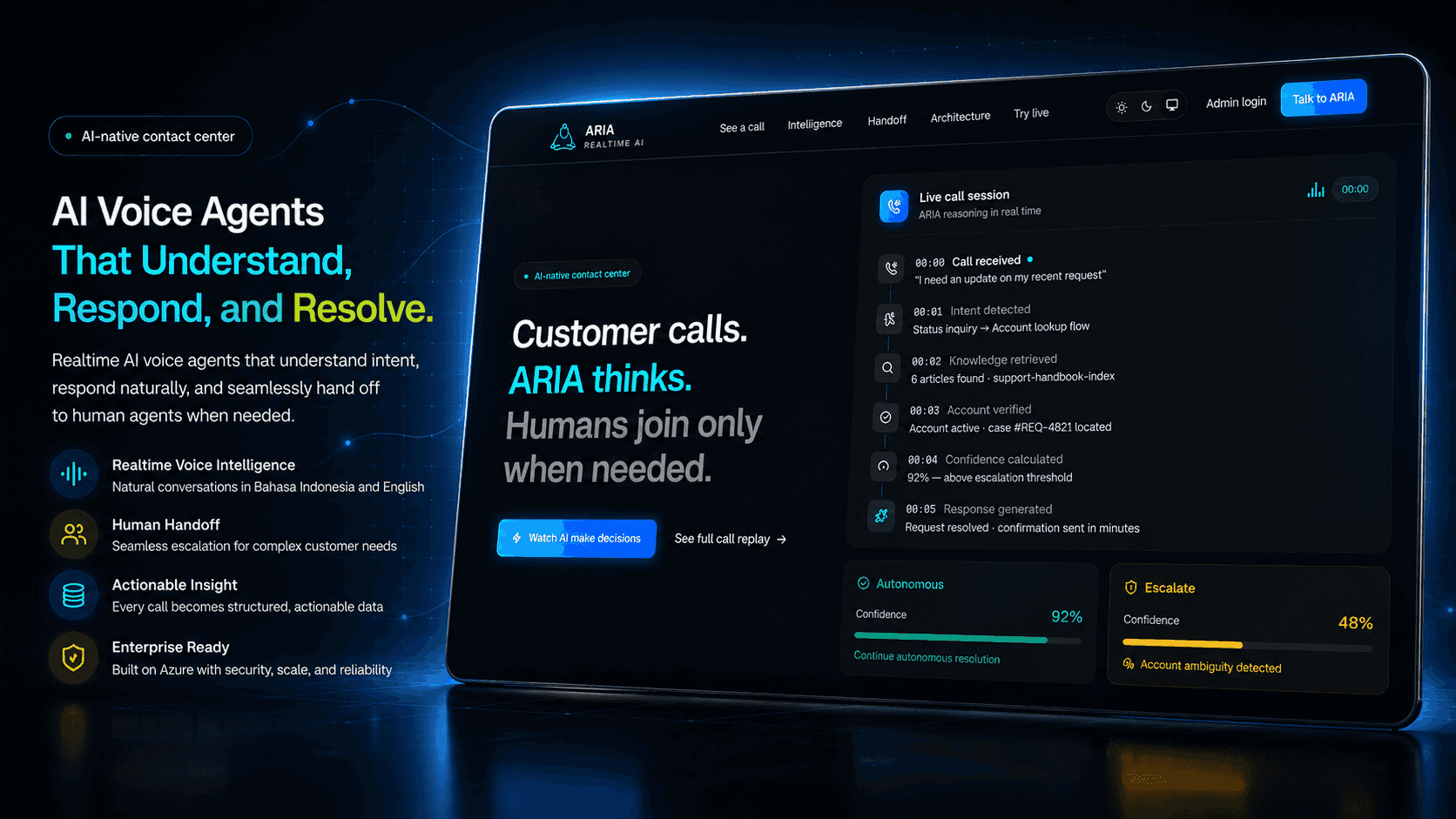
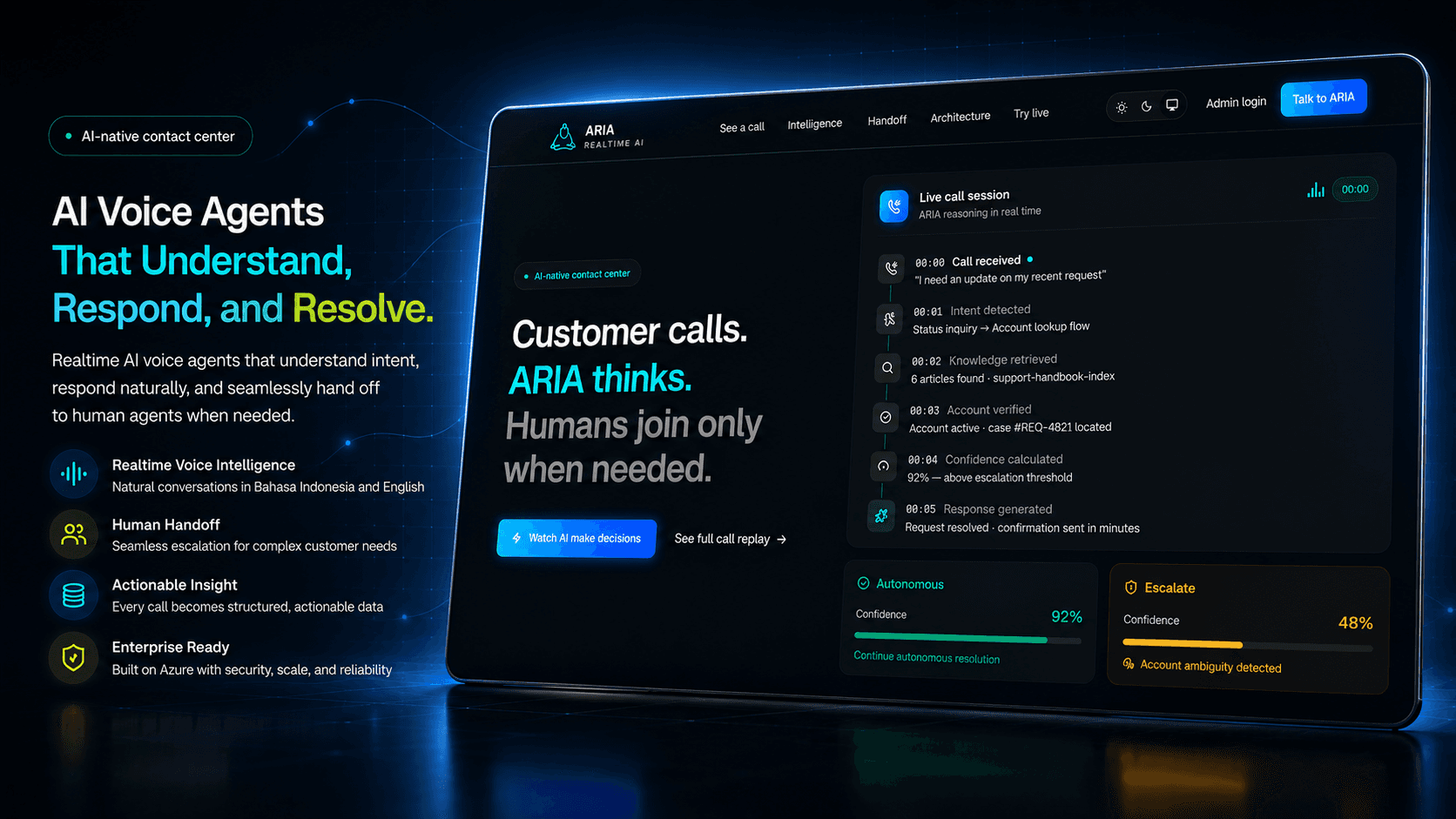
MII Realtime Call (ARIA)
AI-first call center with realtime voice agents.
- Azure OpenAI
- Azure Speech
- Realtime API
- Azure AI Foundry
MII GenAI Chatbot
An enterprise GenAI chat assistant grounded in your knowledge.
- Azure OpenAI
- Azure AI Search
- RAG
- Cosmos DB